By the GoDay.ca Customer Education Team. GoDay is a licensed Canadian online lender that has been helping borrowers understand credit and short-term lending since 2012.
Key Takeaways
- Equifax and TransUnion are Canada’s two national credit bureaus. Each keeps its own file on you and scores it with its own model, which is why the two numbers rarely match.
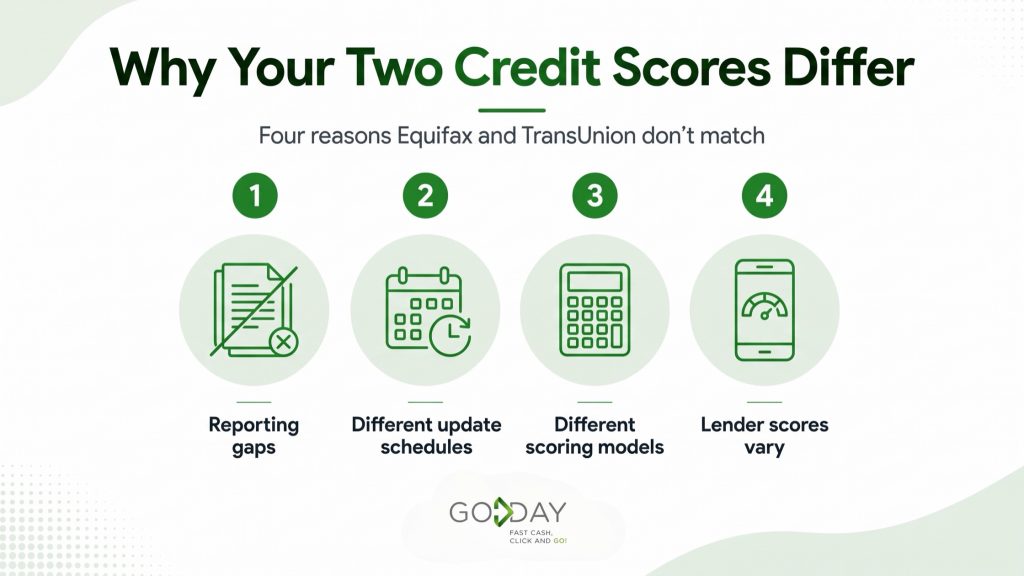
- Scores differ because not every lender reports to both bureaus, creditors report to each bureau at different times, and the scoring models weigh the same information differently.
- Neither bureau is more accurate. Lenders choose which one to pull and can use a different score from the one you see in a consumer app.
- You can get your full credit report from each bureau for free. Equifax provides a free score in every province, while TransUnion’s free score is available only in Ontario and Quebec.
- GoDay’s automated decision doesn’t include a credit check, according to its FAQ, so a gap between your two scores isn’t the deciding factor in a personal or installment loan review.
Equifax and TransUnion are the two national credit bureaus in Canada. Each one collects information about how you’ve borrowed and repaid money, compiles it into a credit report, and turns that report into a three-digit credit score between 300 and 900. They’re separate companies with separate databases, and neither one is the official record.
That separation is why people see two different scores in the same month and assume something is wrong, when usually nothing is. This guide from GoDay explains what each bureau does differently and why your two scores can sit far apart. It also covers which bureau a lender is likely to check, and what to do about an error that shows up on one report but not the other.
What Is the Difference Between Equifax and TransUnion in Canada?
Both bureaus track the same categories of information: your payment history, how much of your available credit you’re using, how long your accounts have been open, the mix of credit you hold, and recent applications. The Financial Consumer Agency of Canada describes a credit report as a summary of how you’ve used credit in the past, and a credit score as a three-digit number derived from it that shows how likely you are to repay.
The differences lie in how each company collects, scores, and refreshes that information.
| The question | Equifax Canada | TransUnion Canada |
| Which consumer score model does it use? | Equifax uses the Equifax Risk Score, a proprietary model scored from 300 to 900. | TransUnion uses the CreditVision Risk Score, a proprietary model scored from 300 to 900 that includes trended data on how your balances have moved over recent months. |
| How often is your score updated? | Equifax updates your score at least once a month, and new data appears as each creditor reports it. | TransUnion also updates your score at least once a month, on the same basis. |
| Can you see your score for free? | Equifax provides a free score in every province and territory, according to the Financial Consumer Agency of Canada’s guide to ordering your credit report. | TransUnion provides a free score only if you live in Ontario or Quebec. |
| Can you get your full report for free? | Yes, online, by mail, or by phone at 1-800-465-7166. | Yes, online, by mail, or by phone at 1-800-663-9980. |
| Where is the Canadian head office? | Equifax Canada’s head office is in Toronto, Ontario, and its parent company is American. | TransUnion Canada’s head office is in Burlington, Ontario, and its parent company is also American. |
Because the models are proprietary, neither company publishes exactly how it weighs each factor. Both confirm that the inputs overlap heavily and the calculations don’t, which is enough to produce different numbers from nearly identical files.
Why Are Your Equifax and TransUnion Scores Different?
Several factors can contribute to a gap, and more than one may apply at once.
- Not every lender reports your accounts to both bureaus. Creditors choose which bureau or bureaus receive their data, and some send it to only one. A credit card reported only to Equifax can affect your Equifax score without appearing on your TransUnion report, and its effect depends on the balance and payment history reported. A missed payment on a loan that reports only to TransUnion can lower that score while Equifax never sees it.
- Creditors report to each bureau at different times. Both bureaus update your score at least once a month, but each creditor chooses when it sends data. If you paid down a large balance last week, one bureau may already show it and the other may not until the next report arrives.
- The two scoring models weigh the same information differently. TransUnion’s CreditVision model looks at the direction your balances have moved over roughly the past two years. So two people with the same balance today can get different TransUnion scores, because the trend behind that balance is one of the factors. Equifax applies its own formula to the same history.
- The consumer score isn’t always the lender’s score. The number in a banking app or on a free credit site is a consumer-facing version. A mortgage lender or a car dealer may pull a different model built for its product, because lenders can apply different scoring formulas, so the score in your app won’t always match the one a lender sees.
If your two scores are far apart, pull both reports and look for an account, an inquiry, or a collection that appears on one and not the other. Our guide to understanding your credit history walks through how to read each section.
Which Credit Bureau Do Lenders Use in Canada?
Lenders decide for themselves, and no rule forces a Canadian lender to use one bureau over the other. Some use different bureaus for different products, and some use one bureau for everything, so ask the lender which bureau it will consult.
You can ask a lender which bureau it used. In Ontario, if you’re turned down based on a credit report and ask within 60 days, the business must tell you which agency supplied it. The inquiry also appears on that bureau’s report afterward. Since you can’t control the choice, the practical strategy is to keep both files accurate and both scores healthy.
Is Equifax or TransUnion More Accurate?
Neither one is more accurate than the other. Both bureaus report what creditors send them, and both make the same kinds of mistakes: a misapplied payment, an account that belongs to someone with a similar name, or a paid collection still showing as open. Accuracy depends on your specific file at each bureau, not on the company.
For you, the more accurate bureau is whichever one has the complete picture of your accounts, and the only way to know is to check both. If one report is missing an account, it holds less information about your borrowing history. How much that matters depends on the account’s payment history, balance, credit limit, and age.
How to Check Both Credit Reports for Free
Every Canadian can get a free copy of their credit report from each bureau. The Financial Consumer Agency of Canada lists three ways to order from each one:
- Online, through each bureau’s website, which is the fastest.
- By mail, by sending the request form with photocopies of two pieces of valid identification.
- By phone, at 1-800-465-7166 for Equifax Canada or 1-800-663-9980 for TransUnion Canada.
Check both reports regularly for errors or signs of fraud. The online versions from both bureaus are free and show information updated every month. Free scores work differently from free reports: Equifax provides a free score across Canada, TransUnion only in Ontario and Quebec, and many banks now show a score inside their apps.
The same agency warns that fraudsters advertise “free credit reports” to harvest personal information. Order from the bureaus directly, or through a bank or credit site you already use, and confirm the address starts with https before you type anything.
How to Fix an Error That Appears on Only One Report
The bureaus don’t share files, so an error has to be disputed with the bureau that holds it. Each has an online dispute process and must investigate with the creditor that reported the item. Send the dispute with any proof you have, such as a statement showing the payment date, and keep a copy.
While the dispute is open, the other bureau’s report is unaffected, which is one reason lenders sometimes see a cleaner file at one bureau than the other. If a lender declines you based on a report you know contains an error, ask which bureau it used so you can dispute with the right one. Our post on common reasons for loan rejections covers the other explanations worth ruling out first.
What Credit Bureau Variations Mean for Personal Lending
For conventional mortgages or bank lines of credit, your bureau file carries heavy weight, and credit problems can affect approval and the terms you’re offered. However, modern alternative financing works differently. Since 2012, our teams have observed that a three-digit bureau score rarely tells a borrower’s whole financial story. Instead of conducting hard credit inquiries that can pull down your rating, our automated platform uses secure bank verification to evaluate household cash-flow consistency and overall affordability. If you are managing a temporary budget gap, you can look at our personal and installment loans as an option to help stabilize your short-term finances smoothly. This approach shifts the focus away from historic bureau discrepancies and onto real-time financial health.
That’s why GoDay’s no credit check loans focus on income and banking activity rather than on whichever bureau score happens to be lower this month. Credit history still matters, though: GoDay’s FAQ notes that an item in collections with another payday or short-term lender makes approval significantly less likely.
If you’d rather improve the scores themselves, start with the habits both bureaus reward. Pay every account on time, keep card balances well below their limits, and avoid a burst of applications in a short period. Our guides to credit score myths that cost you money and building credit without a credit card cover habits that can improve your scores over time.
How GoDay Reviews Applications Without Relying on a Bureau Score
GoDay is a licensed online lender in Canada that has provided structured personal and installment alternatives since 2012. Our decisions weigh real-time income verification rather than baseline bureau scores, allowing borrowers to access customizable short-term loan options without experiencing a hard credit check. Provincial rates are shown before you apply. Loans funded by Interac e-Transfer generally arrive within 60 minutes of funding, and direct deposits follow bank processing times. To see which options fit your situation, you can apply for a loan online in about five minutes, or contact GoDay at 888-984-6329, seven days a week except Christmas Day, if you have questions first.
Frequently Asked Questions
Why is my TransUnion score higher than my Equifax score?
The two bureaus use different scoring models on files that aren’t identical, so a gap is normal. TransUnion’s CreditVision model gives weight to the direction your balances have been moving, so two people with the same balance today can score differently depending on how their balances have moved. The size of the gap alone doesn’t tell you its cause, so compare both reports for differences in accounts, balances, payment history, and inquiries.
Which credit bureau do Canadian banks use?
Each lender chooses, and you can ask which bureau it uses. Some lenders use different bureaus for different products, and some use a single bureau for every decision. The inquiry appears afterward on whichever bureau’s report was pulled, so you can find out after the fact by ordering both reports. Because you can’t predict the choice, the reliable approach is to keep both files accurate and both scores in good shape.
Is Equifax or TransUnion more accurate in Canada?
Neither bureau is more accurate than the other. Both report the information creditors send them, and both can carry errors such as a misapplied payment or an account that belongs to someone else. Accuracy depends on your individual file at each company. The report that gives lenders the truest picture of you includes all of your accounts and none that aren’t yours, and the only way to confirm that is to order both reports and compare them.
How can I check both my Equifax and TransUnion reports for free?
Order each report directly from the bureau online, by mail with two pieces of identification, or by phone at 1-800-465-7166 for Equifax and 1-800-663-9980 for TransUnion. The Financial Consumer Agency of Canada recommends checking both reports regularly, and the free online versions show information updated every month. Equifax also offers a free score everywhere in Canada, while TransUnion’s free score is limited to residents of Ontario and Quebec.
Does a score discrepancy between Equifax and TransUnion affect a GoDay personal loan application?
No. Your specific bureau score metrics do not dictate your eligibility on our platform. GoDay prioritizes stable income and bank account consistency to determine overall affordability for installment loans. This helps individuals with uneven credit scores be considered on their current income, so check that the repayments fit your budget before you borrow. A credit factor that significantly impacts our review is if an applicant has an open, active collection status with an existing short-term lender. Applying doesn’t add a hard inquiry to your Equifax or TransUnion file.


