Key Takeaways
- There’s no one-size-fits-all answer; debt repayment and savings depend on your situation.
- If you have no emergency fund, start building one while making minimum debt payments.
- If you have savings and high-interest debt, paying down debt first may save you more.
- A balanced approach often works best: save, pay debt, and adjust as your finances change.
- Debt snowball and debt avalanche can help you tackle debt in a clear, structured way.
After your regular expenses are covered, you have some money left. Do you use it to pay down debt or put it into savings?
It’s not always an easy decision.
Putting more toward debt can reduce what you’re paying in interest and help you make progress on your balances. But if you put everything toward debt and have little or nothing saved, an unexpected expense could leave you relying on credit again.
So, should you pay off debt first or build your savings?
For many Canadians, it doesn’t have to be one or the other. You can work toward both. How you divide your money depends on the debt you have, what it’s costing you, how much you’ve already saved, and how stable your monthly cash flow is.
Here’s how to decide what makes sense for you.
Should You Pay Off Debt or Save? The Short Answer
Start by looking at what would improve your financial situation right now.
- If you have no emergency savings: Consider building an initial savings cushion while continuing to make your required debt payments. Having some money available for an unexpected expense can reduce the need to borrow again.
- If you already have emergency savings: It may make sense to put more of your available money toward high-interest debt.
- If you’re struggling to make minimum payments: Focus on essential expenses and required payments first. You may also want to speak with your creditors or look into reputable debt support.
- If your debt payments are manageable: You may be able to save and make additional debt payments at the same time.
There isn’t one rule that works for everyone. Your interest rates, income, living expenses, existing savings, and financial goals all affect which approach makes sense.
Start With What You Need to Pay
Before increasing your savings or making additional debt payments, make sure your essential expenses are covered.
That generally includes:
- housing
- groceries
- utilities
- transportation
- insurance
- other necessary living expenses
- minimum debt payments
Then look at what’s left.
A budget spreadsheet, banking app, or the Government of Canada’s Budget Planner can help you compare your income with your actual expenses.
You don’t need a complicated budget. You need an accurate one.
If nothing is left after your essentials and minimum payments, trying to aggressively save and repay debt at the same time may not be realistic. The more immediate issue is your cash flow.
Look at which expenses can reasonably change and whether your monthly debt repayments have become difficult to manage.
Why Emergency Savings Matter Even When You Have Debt
It can be tempting to put every extra dollar toward debt, particularly when you’re paying a high interest rate.
But what would happen if you had an unexpected expense next week?
Without savings, you may have to use a credit card, line of credit, or another form of borrowing. You can end up paying down debt only to take on more when a car repair, urgent home expense, or other unexpected cost comes up.
An emergency fund gives you money to cover expenses that aren’t part of your regular monthly budget without immediately having to rely on credit, but there are loan options available that may have a lower interest rate than your credit card.
The Financial Consumer Agency of Canada (FCAC) recommends gradually working toward emergency savings equal to three to six months of regular expenses or income, starting with a realistic amount and saving gradually.
That doesn’t mean you need to reach that amount before putting anything extra toward debt.
Your first savings goal can simply be an amount that would make a common unexpected expense easier to manage. You can increase your savings cushion over time.
If your income changes from month to month or you’re concerned about an income reduction or job loss, accessible emergency savings may be especially important. Consider how much you’d need to cover essential living expenses if your income temporarily dropped.
You can find more practical information about budgeting and managing your money in GoDay’s financial education resources.
When Should Paying Off Debt Get More Attention?
Debt repayment may need more of your available money when the cost of carrying debt is putting pressure on your budget.
Consider prioritizing additional debt repayment when:
- you’re carrying high-interest debt
- interest charges are making it difficult to reduce your balance
- you have overdue payments
- you’re only making minimum payments month after month
- you’re using a large portion of your available credit
- monthly debt repayments are limiting your cash flow
- you already have some emergency savings
Start by Reviewing Your Monthly Statements
For each debt, write down the balance, interest rate or annual percentage rate (APR), minimum monthly payment, fees, and due date.
Include your credit card debt, student loans, personal loans, lines of credit and other balances. This will help you identify your most expensive debts rather than assuming the largest balance should automatically come first.
Some debts may also need to become priority debts because they’re overdue, have a high cost of borrowing, or could have more serious consequences if payments are missed.
It’s also useful to consider how much of your income is already going toward debt. Your debt-to-income ratio compares your debt obligations with your income and can help give you a broader picture of how much debt is affecting your finances.
Don’t Forget About Credit Utilization
If you’re carrying credit card debt or balances on other revolving credit, check your credit utilization ratio too.
It compares how much revolving credit you’re using with how much is available.
Using less than 30% of your available credit. can lower the amount of interest you’re paying while also reducing your credit utilization.A credit utilization ratio compares how much revolving credit you’re using with the total amount available to you. Keeping balances lower relative to your available credit can help show that you’re not relying too heavily on borrowed money, which may support your overall credit profile.
Debt Avalanche vs. Debt Snowball: Which Strategy Should You Use?
Once your required payments are current, two common debt repayment strategies can help you decide where additional payments should go.
Debt Avalanche
With the avalanche method, you continue making minimum payments on all your debts and put additional money toward the debt with the highest interest rate.
Once that debt is paid off, you move to the next-highest interest rate.
The main advantage is reducing interest costs. If your priority is paying less interest over time, this method may make sense.
Debt Snowball
With the debt snowball method, you make the required payments on all your debts and put additional money toward your smallest balance.
Once that balance is paid off, you move to the next-smallest.
The snowball method may not minimize interest as effectively if your smaller balances have lower rates. However, paying off individual debts sooner can make your progress easier to see.
Comparing Debt Avalanche vs. Debt Snowball
| Strategy | What You Pay First | Main Benefit |
| Debt Avalanche | Highest interest rate | Can reduce total interest costs |
| Debt Snowball | Smallest balance | Creates earlier repayment milestones |
The right debt repayment strategy is the one that fits your financial situation and that you can follow consistently.
When Should Savings Get More Attention?
There are situations where building savings may be more important than making additional debt payments.
That may be the case if:
- you have little or no emergency savings
- your income varies
- you’re concerned about reduced hours or job loss
- you regularly use credit for unexpected expenses
- you know a necessary expense is coming
- your existing debt has manageable payments
- you’re working toward an important short- or medium-term goal
The purpose isn’t to ignore your debt. Continue making your required payments.
What Is the Point of Emergency Savings?
Building emergency savings can reduce the chance that the next unexpected expense becomes additional debt.
Savings can also include longer-term financial goals. Depending on your circumstances, you may be contributing toward retirement through an RRSP, a TFSA, a workplace retirement plan, or another investment account.
If your employer offers matching retirement contributions, consider that benefit as part of your financial priorities. When you’re balancing expensive debt against longer-term investments, a qualified financial advisor can also help you assess your individual circumstances.
How Can You Save and Pay Down Debt at the Same Time?
For many Canadians, balancing debt repayment and savings can be more realistic than choosing one and completely ignoring the other.
After your essential expenses and minimum debt payments are covered, you can divide the money that’s left between emergency savings and additional debt repayment.
The split doesn’t have to stay the same. If you have almost nothing saved, you might initially put more toward building a savings cushion. Once you have some emergency savings, you may decide to direct more toward high-interest debt.
And when you finish paying off a debt, consider redirecting some or all of that old monthly payment toward your next debt or savings goal.
Make It Part of Your Payday Routine
A simple routine can make both goals easier to maintain.
When your direct deposit arrives:
- Set aside money for essential expenses.
- Make your required debt payments.
- Make your planned savings contribution.
- Put any planned additional payment toward your priority debt.
- Leave enough for realistic everyday spending until your next payday.
Automating savings with a recurring transfer into a separate savings account after you’re paid can make building savings easier.
Depending on your employer and financial institution, a payroll deduction may also be available.
Regular monthly savings contributions can help you work toward your savings goals without having to decide how much to transfer every payday.
What If You Can’t Afford to Do Both?
Sometimes there simply isn’t enough left after your regular expenses and minimum payments to save and make additional debt payments.
If that’s where you are, don’t set an aggressive goal that makes it harder to cover necessities. Look at what’s putting pressure on your budget. Have your living expenses increased? Has your income changed? Are interest fees taking up a large part of your debt payments? Are several minimum payments due each month?
If you’re having difficulty making the minimum payments themselves, the priority shifts from paying debt down faster to getting your finances back to a manageable point.
A reputable credit counsellor can help you review your budget and understand the options available to you. Before choosing one, it can help to understand what credit counselling involves and look for accredited credit counselling services in your area.
Could Debt Consolidation Help?
If several debt payments are taking up a large part of your monthly cash flow, debt consolidation may be worth exploring.
Debt consolidation generally involves combining multiple debts into one debt or payment. Depending on the terms available to you, consolidating higher-interest balances at a lower interest rate could reduce interest costs or make repayment easier to manage.
Options can include a consolidation loan, line of credit, or balance transfer credit card. But don’t judge a consolidation option by the monthly payment alone.
A lower payment over a longer repayment period could result in more interest being paid overall. Compare the interest rate, fees, repayment period, and total cost of borrowing before deciding if a debt consolidation loan is right for you.
Common Mistakes When Balancing Debt and Savings
Putting All Your Savings Toward Debt
Using your savings to reduce high-interest debt can lower your borrowing costs, but consider how much you’ll have left afterwards. If the payment leaves you with no emergency savings, you could end up relying on credit again when an unexpected expense comes up.
Building Savings While Expensive Debt Keeps Growing
The opposite can also slow your progress. If you already have a reasonable savings cushion but are paying a high cost of borrowing, compare the interest you’re earning on savings with the interest and fees you’re paying on debt. Additional debt repayment may deserve more of your available money.
Relying on Credit for Every Unexpected Expense
Available credit isn’t the same as emergency savings. Savings are funds you already have. Borrowing needs to be repaid and may come with high interest and fees.
Building even a modest emergency fund can reduce how often an unexpected expense leads to another balance you need to repay. If you do need to consider borrowing for a temporary cash-flow gap, it’s important to understand your options and how repayment will fit into your budget.
A Quick Debt vs. Savings Checklist
Still not sure which should come first? Work through these questions.
- Are your essential expenses covered?
If not, start there. - Can you make your minimum debt payments?
If not, contact your creditors and consider reputable debt support. - Do you have any emergency savings?
If not, consider building an initial savings cushion while keeping required payments current. - Do you have overdue or high-interest debt?
If so, those balances may need more attention once you have some emergency savings available. - Are your debts manageable and your emergency savings growing?
If so, you may be able to continue working toward both goals.
Your answer can change as your finances change.
Should You Prioritize Debt or Savings?
There isn’t one answer that applies to every household.
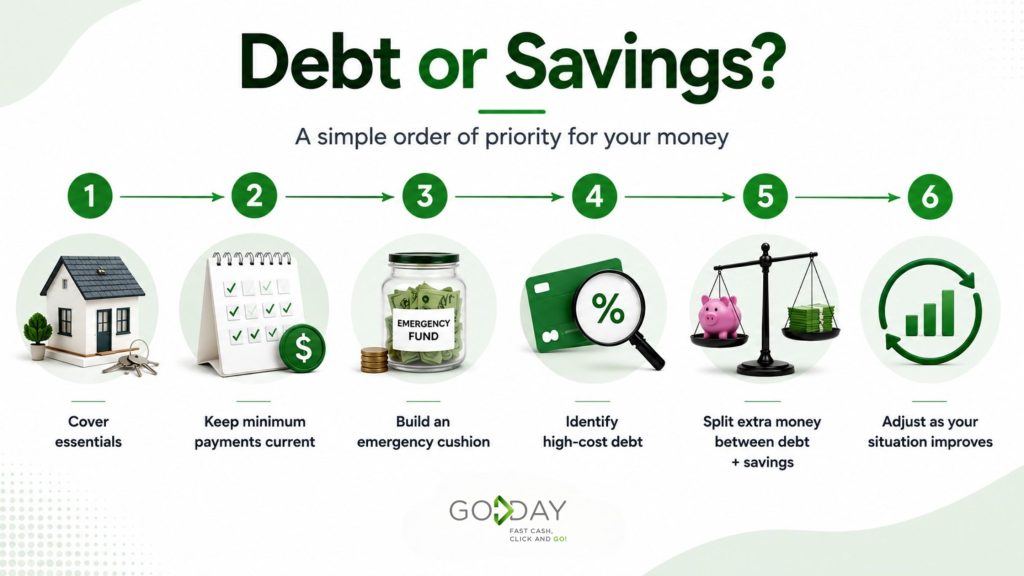
A practical order to consider is:
- Cover essential living expenses.
- Keep required debt payments current.
- Start building emergency savings.
- Identify high-cost and priority debts.
- Use additional money for debt repayment and savings based on your circumstances.
- Adjust the balance as your debt decreases and your savings grow.
If you have no emergency savings, building an initial cushion can give you money to use when an unexpected expense comes up.
If you already have savings but are carrying expensive debt, putting more toward repayment may help reduce your interest costs.
And if you have enough room in your budget to do both, you don’t necessarily need to wait until one goal is complete before starting the other.
The goal is to make your finances easier to manage over time: reduce what you’re paying in interest, rely less on credit for unexpected costs, and build savings you can use when you need them.
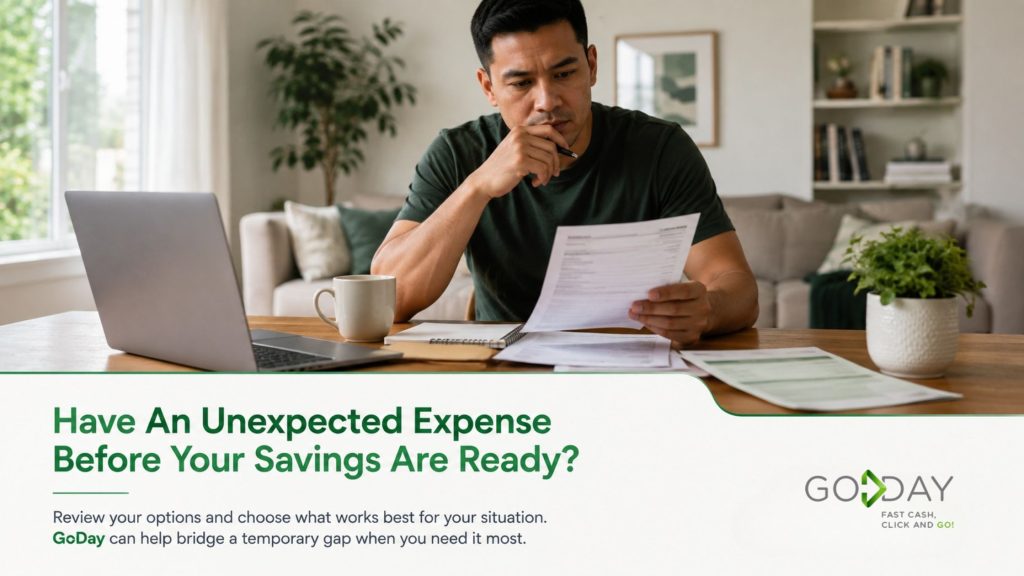
Have An Unexpected Expense Before Your Savings Are Ready?
Building an emergency fund takes time, and an unexpected expense may come up before you’ve saved enough to cover it. Start with the options already available to you. Check whether you can use some emergency savings, adjust non-essential spending, arrange a payment plan, or use another lower-cost option.
If you still have a temporary cash-flow gap after reviewing those options, you can look at GoDay’s short-term borrowing options to see whether they may fit your situation. Before making a decision, consider the costs, repayment terms, and how repayment would fit within your upcoming budget.
FAQs
How do I balance debt repayment and savings simultaneously?
Balancing debt and savings starts with a budget spreadsheet tracking income, monthly debt repayments, and savings goals. Set financial goals like building an emergency fund while making minimum debt payments. Automate savings through direct deposit or payroll deduction so money moves before spending. This creates a savings cushion without sacrificing debt repayment strategies. Monitor your debt-to-income ratio, ensuring monthly debt repayments stay manageable. Even small amounts toward savings goals help. Start with one month of expenses, then grow your emergency fund gradually while maintaining minimum payments on all debts.
What common mistakes should I avoid when choosing between debt and savings?
Common mistakes include skipping emergency savings to pay credit card debt, then facing an unexpected expense forcing high-cost borrowing through fees. This revolving door prevents rebuilding credit. Another error: ignoring your budget and financial goals while focusing only on mortgage payments or student loans. Non-revolving debt should be balanced with liquid savings. Avoid paying minimums without a plan. Build emergency savings first, then tackle credit card debt aggressively. This prevents falling back into the revolving door and supports rebuilding credit long-term.
How can debt consolidation or refinancing help me save more?
Debt consolidation combines multiple balances into one payment through refinance loans or a balance transfer credit card. Canadian credit counseling offers free guidance. Use a debt advice locator tool to find nonprofit credit counseling near you. Financial calculators help compare debt consolidation versus debt reduction/savings goals. Secured credit cards or secured credit lines can rebuild credit after consolidation. College forgiveness programs may help student borrowers. Refinancing loans lowers interest rates, freeing cash for savings. Always read terms carefully, using financial calculators to ensure consolidation supports your debt reduction/savings goals.
Should I prioritize debt repayment or building emergency savings first?
Deciding between debt repayment and emergency savings depends on interest rates and peace of mind. High-interest credit card debt usually wins, but having a savings account with $1,000 reduces stress. Use a debt management calculator and a savings calculator to compare scenarios. Financial literacy helps you understand that loans above 10% should be prioritized, but emergency savings prevent new debt. Balance both by setting financial goals: save one month of expenses, then focus on debt repayment. Adjust based on your situation. Financial literacy reduces stress, helping confident decisions about credit card debt versus savings.
How do I identify and manage my highest-interest debts?
Identify high-interest debts by reviewing monthly statements for APR and interest rate on credit card debt, payday loans, and loans. Priority debt includes anything above 15% APR. Use the avalanche method targeting the most expensive debts first, or the debt snowball method for wins. Both require minimum monthly payments on all accounts while extra cash flow goes to one debt. Emergencies happen; keep a small buffer while attacking high-interest balances. Payday loans often exceed 300% APR and should be eliminated first. Understanding which debt costs most helps focus your debt repayment strategy where it matters.
How should I prepare for economic challenges like job loss?
Preparing for economic challenges like job loss or income reduction starts with a budget tracking living expenses and cost of living. Build emergency savings covering three to six months for financial flexibility. Review credit reports annually, catching errors affecting debt management. A savings cushion protects against medical bills without touching retirement funds. Reduce discretionary spending when the cost of living rises. Financial flexibility means having options when income reduction hits. Prioritize emergency savings before extra debt payments. This buffer prevents new debt during tough times, supporting long-term debt management even when facing job loss or medical bills.
What are the pros and cons of focusing on debt versus savings?
Debt repayment strategy pros include eliminating interest fees and reducing financial stress. The avalanche method saves the most on annual percentage rate, while the snowball method builds momentum. Cons: aggressive repayment leaves you vulnerable to unexpected expenses. Savings cushion pros include security for emergencies. Cons: savings earn less than debt costs in interest fees. An unsecured loan or secured loan through refinance consolidates debt at lower rates. Tax relief may apply to investments but not consumer debt. Balance both: maintain a savings cushion while using the avalanche or snowball method, reducing financial stress.
What role does an emergency fund play in my overall strategy?
An emergency fund acts as a financial cushion against unexpected expenses, preventing new debt. Bankrate’s emergency savings report recommends three to six months of living expenses; start with $1,000. Use a high-yield savings account or liquid account for access. Budget monthly savings contributions toward your emergency savings goal. Even small amounts build your savings account over time. This emergency savings buffer protects your budget when surprises hit. Once reaching three to six months, redirect extra to debt. The key is consistency: monthly savings contributions create the financial cushion preventing debt cycles.
When should I prioritize paying off debt over saving?
Prioritize debt repayment when interest rates exceed 10%, especially credit card debt. A high credit utilization ratio hurts your score, making balance transfer cards attractive. Focus on priority debts first, making minimum payments on others. If overdue payments loom, address those immediately, avoiding penalties. A debt reduction plan or debt management plan through a counselor helps. The snowball method works if you need motivation. Build a small emergency fund first, then attack debt aggressively. Consult a financial advisor if overwhelmed. Prioritizing high-interest credit card debt reduces interest paid and improves credit utilization ratio.
When is it better to prioritize savings over debt repayment?
Prioritize savings when your employer matches a 401(k) or retirement plan—that’s free money. Build an emergency savings safety net covering living expenses before aggressive debt payoff. Use a budget spreadsheet tracking short-, mid-, and long-term goals. A top-yielding savings account or money market earns competitive rates. Investment accounts offer tax-free investment growth for wealth. An individual retirement account provides retirement income with tax advantages. Financial priorities shift: emergency fund first, then retirement, then debt. If your job lacks stability, prioritize savings. Balancing a retirement plan with debt repayment ensures building wealth.
How can GoDay help me manage unexpected expenses without derailing my plan?
GoDay offers short-term loans for unexpected expenses when your emergency fund falls short. While not long-term, it prevents the high cost of borrowing from late fees. Use GoDay to maintain minimum payments on monthly debt repayments during cash flow gaps. This protects your budget and financial goals. Pair GoDay with building an emergency savings cushion for financial flexibility. Repay quickly, minimizing costs. GoDay bridges temporary gaps so you continue debt repayment without derailing progress. Responsible use means borrowing only what is needed, repaying on time, and focusing on building emergency savings. This maintains financial flexibility while working toward financial goals.
How do I create a balanced action plan for both debt and savings?
Create your action plan with a budget spreadsheet listing income, minimum debt payments, and savings goals. Set financial goals for debt reduction and emergency fund targets. Automate savings through direct deposit or payroll deduction, moving money automatically. This builds a savings cushion without manual effort. Choose debt repayment strategies like avalanche or snowball based on motivation. Start with one month’s expenses in your emergency fund, then increase. Balance monthly debt repayments with savings contributions. Financial flexibility comes from having both debt reduction progress and a savings cushion. Review your budget spreadsheet monthly, adjust, automate savings, and celebrate milestones.